
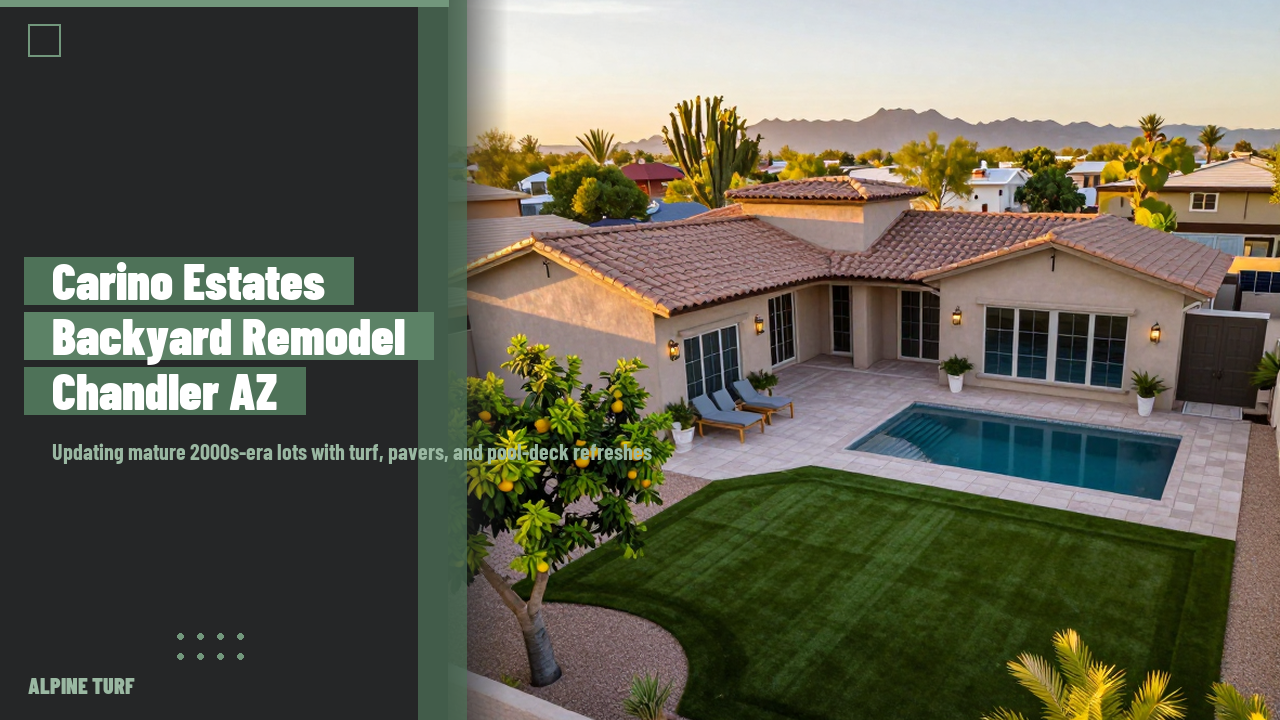
A Carino Estates backyard landscaping project today is a different job than the one that went in when the neighborhood was built. Shea Homes finished most of Carino Estates between 1999 and 2003, which means a majority of these roughly 720 Tuscan-style homes near Queen Creek Road and Arizona Avenue in Chandler's Ocotillo area are now 20-plus years into their original landscape package. The Bermuda sod has been overseeded and mowed for two decades, the pool decking has been through that many monsoon seasons, and the citrus trees planted as 5-gallon saplings are now mature enough to have root systems under the patio.
None of that shows up in a real estate listing, but it shows up in a water bill, a cracked expansion joint, or a dead patch of lawn that won't come back. This post covers what's actually different about landscaping a Carino Estates lot at this age, what the HOA has to say about it, and how we scope a remodel so the next 20 years go better than the last five.
Carino Estates Backyard Landscaping Chandler AZ: What You're Actually Working With
Carino Estates sits in the Ocotillo area of Chandler, built out mostly between 1999 and 2003 with Tuscan-inspired architecture: stucco exteriors, tile roofs, three to five bedrooms, and an average home size around 2,500 square feet. A large share of the lots came with a backyard pool at original construction, plus an extended covered patio and a grass play area bordered by citrus and shade trees — standard builder-grade landscaping for a Chandler community of that era, maintained well by most owners since.
That standard package is exactly what's aging out now. Bermuda sod from the late '90s and early 2000s was never meant to run 20-plus years without a full renovation; pool decking poured in that window is showing the expansion-joint cracking and surface pitting typical of two decades of Arizona sun; and citrus trees that were decorative accents in 2001 are now large enough that their root zones overlap the patio, the pool deck, or the turf area a homeowner wants to install.
What 20-Plus Years Does to a Carino Estates Backyard
Three things wear out on roughly the same timeline in a Carino Estates yard, and they're worth tackling together rather than one at a time:
- Natural grass that costs more to keep than it's worth. Bermuda needs full-sun exposure and consistent water to stay green through a Chandler summer. Two decades of soil compaction, thatch buildup, and heat stress mean most original lawns in Carino Estates now need re-sodding every few years just to look presentable — at which point the water and maintenance math stops favoring real grass.
- Pool decking that's past its practical life. Poured concrete decking from the early 2000s has typically absorbed 20-plus years of monsoon cycling (expansion, contraction, minor settling) and chlorinated splash-out. Hairline cracks, spalling at the coping, and a deck surface that's gotten rougher and hotter underfoot are the norm, not the exception, at this age.
- Irrigation lines that were never meant to run this long. Original PVC drip and spray lines installed in 1999–2003 are well past the point where leaks, root intrusion, and valve failures start outnumbering the sections still working as designed. Any turf or hardscape project on a lot this age should assume some irrigation rerouting, not a simple cap-and-cover.
Getting Your Plan Approved: What Carino Estates Actually Requires
Carino Estates is professionally managed, and like most Chandler HOAs, exterior landscaping changes go through an architectural or design review process before work starts. We looked for a publicly posted Carino Estates design guidelines document the way we do for communities like Fulton Ranch or Ocotillo, and as of this writing we haven't found one posted online. That's not unusual for a smaller, older community — it just means the specifics (granite colors, border materials, submittal deadlines) live with the management company rather than in a document we can link you to directly. We confirm the current requirements with the HOA office before finalizing any design, the same way we would if you called yourself.
One thing we can tell you with certainty regardless of what Carino Estates' own paperwork says: Arizona's HB2131, signed in 2022 and codified at A.R.S. §33-1819, prohibits any HOA that allows natural grass from banning artificial turf outright on a member's property. The association can still set reasonable rules about turf's appearance and installation (blade height, color, visible seams, licensed-installer requirements), but it can't tell you no on principle. If anyone representing the HOA tells you turf isn't allowed at all, that's worth pushing back on with the statute in hand.
What we do as part of every Carino Estates quote: call the management company, get the current submittal requirements and any turf or granite specification sheet in writing, and build the plan to match before anything goes in the ground. That's standard practice for any established HOA where we can't verify the rules from a public document.
Swapping Bermuda or Rye for Turf on an Established Lot
Replacing a 20-year-old Bermuda lawn with artificial turf isn't the same job as installing turf on a new-construction dirt yard. The existing lawn has to come out completely — sod, thatch layer, and root mat — because leaving organic material under turf is one of the most common causes of soft spots, odor, and drainage failure down the line. On a lot this age we typically find 2 to 4 inches of built-up thatch and root material that has to be stripped before we can even start grading.
Once the old lawn is out, the base goes in the same way it would on a new lot: compacted crushed granite, graded with a slight slope away from the house, then turf pinned and seamed over a weed barrier. The difference on an established lot is almost always what's underneath or around that old lawn — original irrigation lines that need to be capped or rerouted rather than just abandoned in place, and sprinkler heads that have to come out cleanly instead of being buried under new base material. We cover the irrigation side of a turf conversion in more detail in our sprinkler and turf conversion guide.
Pool Deck and Patio Refreshes for Carino Estates Lots
Because so many Carino Estates lots came with a backyard pool at original construction, the pool deck is usually the single most important surface in the remodel — and the one most likely to have real problems by now. Original poured-concrete decking from the early 2000s typically shows hairline cracking at the expansion joints, a rougher and hotter surface than it had when it was new, and sometimes minor settling where the deck meets the coping.
The fix that holds up best on a deck this age is a travertine or paver overlay rather than a straight re-pour: it goes directly over sound existing concrete, costs less than demo-and-replace, and gives you a cooler, non-slip surface around the water instead of bare broadcast concrete. Where turf borders the new deck — a common Carino Estates combination, since most lots have room for a turf strip between the pool and the block wall — we set the paver edge first and run the turf up to a clean, pinned border rather than letting the two surfaces fight each other at the seam. For more on combining the two surfaces well, see our turf and paver combo design guide.
Mature Citrus, Root Systems, and Old Irrigation Lines
The trees that make a 20-year-old Carino Estates yard feel established are also the part most likely to complicate a turf or paver install. Citrus trees in particular develop a wide, shallow root system over two decades, and those roots are often sitting right under the patio slab, the pool deck, or the exact spot where a homeowner wants a clean rectangle of turf.
We don't cut through root systems to force a straight edge. Turf gets a root-safe cutout around the trunk with enough clearance for the tree to keep taking up water, and the base underneath gets hand-excavated near major roots instead of machine-graded flat. Citrus also needs its own watering separate from turf (artificial turf obviously doesn't need irrigation, but the tree still does), so we leave or reroute a dedicated drip line to the root zone even after the surrounding lawn comes out. Skipping this step is the single most common reason we get called out to a Carino Estates yard a year or two after someone else's install, usually because a mature tree started declining once its original Bermuda-era watering pattern disappeared along with the grass.
What a Carino Estates Remodel Actually Looks Like
Most Carino Estates projects fall into three rough tiers, scaled to how much of the original landscape package is being replaced:
| Scope | What's included | Typical range |
|---|---|---|
| Refresh | Turf swap on the existing lawn footprint, granite touch-up, irrigation capping | $5,000–$9,000 |
| Partial rebuild | Turf plus a new paver patio extension or pool-deck overlay, updated plant bed, root-safe tree cutouts | $12,000–$22,000 |
| Full rebuild | Turf, full pool-deck overlay, extended patio, lighting, and irrigation rerouting across the whole lot | $25,000–$35,000+ |
Where a project lands in that range depends mostly on how much of the original 2000s-era hardscape and irrigation gets touched, not on turf price alone — demo, root work, and drainage correction on an established lot typically cost more than the turf itself.
How Alpine Turf Handles a Carino Estates Project
We're a full East Valley landscape installer, not a turf-only crew, which matters on a lot this age because the turf is rarely the hard part. We pull the current HOA submittal requirements from the management company before we design anything, strip the old lawn down to clean soil instead of covering it over, reroute or cap irrigation properly instead of leaving dead lines buried in the base, and work around mature trees with root-safe cutouts rather than forcing a straight edge through a root zone. On projects that include the pool deck, we scope the overlay or repair alongside the turf and paver work so the whole backyard gets handled as one job instead of three separate contractors.
Project scope at Carino Estates tracks closely with what we see across Chandler backyards generally, with the added wrinkle of a mature lot's existing infrastructure. Whatever the scope, we confirm the HOA's current requirements and handle that paperwork as part of the quote.
Frequently Asked Questions
Does Carino Estates' HOA allow artificial turf?
Yes, with some rules on appearance. Arizona's HB2131 (2022), codified at A.R.S. §33-1819, prohibits any HOA that allows natural grass from banning artificial turf outright. Carino Estates can still set reasonable standards for how it looks and how it's installed, which we confirm with the management company before finalizing a design since we haven't found those specifics published publicly.
Who manages Carino Estates and how do I get my landscape plan approved?
Carino Estates is professionally managed, and exterior landscaping changes go through the HOA's review process before work starts. We haven't located a public design guidelines PDF for the community, so as part of every quote we call the management company directly to confirm current submittal requirements rather than guess at them.
How much does a Carino Estates backyard remodel cost?
Most projects we quote fall into three tiers: $5,000–$9,000 for a turf swap and granite refresh on the existing footprint, $12,000–$22,000 for turf plus a paver patio extension or pool-deck overlay, and $25,000–$35,000 or more for a full rebuild covering turf, pool deck, patio, and irrigation. Lots needing significant root work or drainage correction run toward the higher end.
Will mature citrus trees interfere with a turf installation?
They can if the root zone isn't handled correctly. We hand-excavate near major roots instead of machine-grading flat, cut a root-safe opening around the trunk, and leave or reroute a dedicated drip line so the tree keeps getting water after the surrounding Bermuda lawn is removed.
What happens to my old pool deck if I add turf around it?
Most 20-plus-year-old concrete pool decks in Carino Estates are candidates for a travertine or paver overlay rather than a full tear-out, since it goes directly over sound existing concrete and costs less than demolition. We set a clean, pinned paver edge first, then run turf up to that border so the two surfaces don't fight each other over time.
How long does a Carino Estates remodel take?
A turf-and-granite refresh on an existing footprint typically takes 2–3 days on site once HOA approval and permits (if a structure is involved) are in hand. A full rebuild including a pool-deck overlay and patio extension usually runs 5–8 days depending on how much irrigation rerouting and root work the lot needs.
Keep reading.
Ready to ditch the grass?
We install premium artificial turf across the East Valley: Gilbert, Chandler, Mesa, Queen Creek, San Tan Valley. Free on-site measure and quote, no obligation.
Book your free quote