
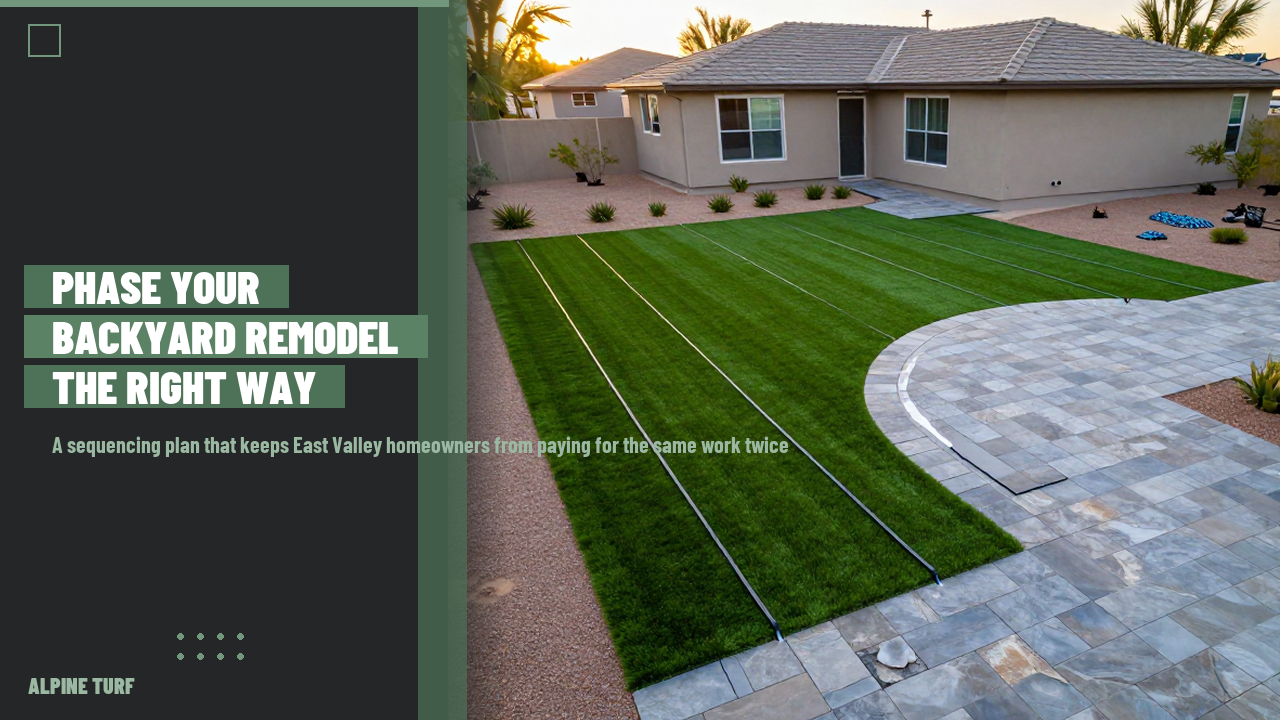
Nearly every East Valley backyard remodel we price out this year gets asked the same question before a single yard of dirt moves: can we do this in phases? The honest answer is yes, almost always, but only if the first phase gets scoped by someone already thinking about phase three. A backyard remodel in phases Arizona homeowners can trust without blowing up the second or third budget starts underground, with decisions about sleeves, grading, and drainage that cost almost nothing to get right now and real money to fix once the yard is built on top of them.
We've walked plenty of East Valley yards where a homeowner handled Phase 1 turf and hardscape two years ago, now wants a pergola and an outdoor kitchen added, and the quote comes in higher than it should because every conduit run means trenching back through cured concrete or seamed turf that was never built to be reopened. This guide walks through how to plan a phased backyard remodel the right way: what has to go in during Phase 1 no matter how small the current budget is, how grading and drainage lock in decisions you can't easily revisit, realistic phase-by-phase costs, and the build sequence that keeps a second and third phase from costing more than they should have to.
Why a Backyard Remodel in Phases Arizona Homeowners Choose Makes Sense
Most East Valley backyard projects we build are not written as a single check. Families space a full remodel across a tax refund, a bonus, a home equity draw, or simply the twelve months it takes to save for the next stage. Alpine Turf builds projects from a $5,000 refresh (turf, plants, and a lighting tune-up on an already-finished yard) up to $100,000+ custom outdoor living builds with pools, kitchens, and engineered shade structures, and the gap between those two numbers is almost always filled by homeowners phasing the work rather than financing the entire project at once.
There's nothing wrong with that approach. What causes the budget overruns we get called in to fix isn't phasing itself, it's phasing without a whole-yard plan behind it. A Phase 1 scoped only for the turf going in this year, with no thought given to where next year's paver patio or the outdoor kitchen after that will sit, almost guarantees the later phases cost more than a single coordinated build would have. The fix isn't to avoid phasing. It's to design and grade the entire yard once, then build it out zone by zone as the budget allows.
Phase One: Lock the Whole-Yard Plan and Run the Infrastructure You Can't Add Later
Phase 1 of any properly phased remodel isn't the turf, the patio, or even the plants. It's the design and the underground work, and it needs to cover the entire lot even if you're only paying to build out a third of it right now. If you're planning a pergola or an outdoor kitchen two phases from now, the electrical conduit and gas line stub for it should go in during Phase 1, capped and marked, while the yard is already open. We cover the specific mechanics of capping, rerouting, and staging existing sprinkler lines around a turf install in our sprinkler rerouting guide, and the same logic extends to any utility you know you'll want eventually: irrigation mainline and valves sized for the full yard, low-voltage lighting conduit under any future paver patio, and a drainage sleeve under any walkway that will eventually connect two zones.
This is also the phase to take your full design to the HOA, even if construction is going to happen in stages. Communities across the East Valley, from Eastmark and Power Ranch to Spur Crossing and Encanterra, generally run a 2 to 6 week architectural review cycle per submission. Submitting the complete yard plan once, with a note that construction will occur in phases, is far faster and cheaper than resubmitting a new application for every phase as it comes up, and it avoids the scenario where an HOA approves Phase 1 turf but later pushes back on a Phase 3 shade structure that doesn't match what they originally signed off on. Our HOA approval guide walks through what a submission package should include.
Grading and Drainage: The One Phase You Can't Revisit Cheaply
Most East Valley lots sit on a thin layer of builder topsoil over dense clay and caliche subsoil that barely percolates, something we go into in more depth in our clay soil yard problems guide. That subsoil doesn't change phase to phase, and neither should your grading plan. We set final grade across the entire lot in Phase 1, roughly a 2% slope, about a quarter inch of drop per foot, moving water away from the foundation and toward a single approved exit point for the whole yard, not just the section being built this year.
The reason this can't wait is structural, not aesthetic. Once turf or pavers go in over a grade that was only partially thought through, correcting it means tearing out whatever was built on top. We've been called to fix backyards where Phase 1 turf was laid dead flat because "the patio isn't happening until next year," and by the time Phase 2 arrived, the flat turf panel was holding water against the house during monsoon season and had to be pulled up and reset before the patio base could even go in. Grading the whole lot once, during Phase 1, is the cheapest insurance in the entire project.
Choosing What Goes In First: Turf, Pavers, or Planting
Once the underground work and grading are locked in, the question becomes which surface to build first. Turf is usually the fastest way to get a usable, presentable yard and the lowest cost per square foot, but it also commits to a footprint, so any future paver patio or path that will cut into that turf area needs its edges marked and sleeved before the turf goes down, not guessed at later. Pavers locked in first are a stronger choice when the patio footprint is the one thing you're certain about in the whole design, such as a covered entertaining space you know won't move regardless of what gets added around it in later phases.
Planting runs on its own calendar, independent of which surface phase you're funding. Arizona's real planting window is October through March, when new root systems can establish before summer heat arrives, so if Phase 1 lands in the spring or summer, it's often worth planting trees and foundation shrubs ahead of schedule even if the hardscape budget isn't ready yet, rather than waiting a full year for the next planting window to open. A tree planted a year early has a year's head start on shade by the time the rest of the yard catches up to it.
Budgeting Each Phase Without Paying Twice for Mobilization
Every time a crew mobilizes to a job site, there's a fixed cost baked into the quote: equipment delivery, a minimum crew day, disposal fees for whatever gets demoed. Splitting a project into three separate contracts with three separate contractors means paying that mobilization cost three times. The way around it isn't to avoid phasing, it's to get one licensed installer to scope the entire project as a single master plan broken into priced phases, with Phase 1 pricing locked regardless of when Phase 2 and 3 actually get built. That protects you from a installer pricing later phases at a premium once they know the yard is already partially built and switching contractors is inconvenient.
Realistic phase budgets for a typical East Valley backyard: Phase 1, covering design, whole-lot grading, drainage, and infrastructure sleeves, runs $8,000 to $18,000 depending on lot size and how much excavation the site needs. Phase 2, the surface layer of turf or pavers for the primary living area, runs $12,000 to $35,000. Phase 3, shade structures, lighting, and an outdoor kitchen or fire feature, runs $10,000 to $60,000 or more depending on scope. Before signing anyone for Phase 1, confirm they hold an active Arizona Registrar of Contractors license; our contractor vetting guide covers how to check that through the AZ ROC public license search, and it matters even more on a phased project since you may be relying on that same license and warranty two or three years down the road.
The Four-Phase Sequence That Keeps Your Later Phases Honest
The order matters as much as the materials, and it doesn't change just because the money shows up in installments. Here's the sequence we build to on every phased East Valley project, regardless of how many budget cycles it ends up spanning.
Design the whole yard and submit one HOA package
Even if you're only building a third of it this year, the design covers the full lot, and the HOA submission covers the full plan. This is the cheapest step to get right and the most expensive to skip.
Grade the entire lot and run every sleeve you'll ever need
Final grade, drainage path, and every conduit, irrigation, and gas sleeve for future phases go in while the yard is still open dirt. Cap and mark anything that won't be connected until a later phase.
Build out surfaces zone by zone as budget allows
Turf, pavers, and planting go in for whichever zone is funded first, built against the whole-lot grade already established, so the next zone slots in without disturbing what's already finished.
Add shade, lighting, and outdoor living last
Pergolas, kitchens, and fire features connect to the sleeves run in Step Two, so by the time this phase arrives there's no demo involved, just finish work on top of infrastructure that's already been sitting there, capped and waiting.
Common Phasing Mistakes East Valley Homeowners Make
Frequently asked questions
How many phases should I split my Arizona backyard remodel into?
Most East Valley homeowners land on two or three phases: infrastructure and grading first, the primary turf or paver surface second, and shade structures or an outdoor kitchen third. Fewer, larger phases generally cost less overall than many small ones, since each phase carries its own mobilization cost.
What absolutely has to go in during Phase 1, even on a tight budget?
Whole-lot grading and drainage, plus any electrical conduit, irrigation line, or gas sleeve you know you'll want for a future phase. These are the items that cost roughly $150 to $400 to install correctly up front and $1,500 or more to retrofit once hardscape or turf is in place over them.
Does phasing a remodel cost more in total than building it all at once?
Phasing done correctly, with one whole-yard design and infrastructure plan up front, costs close to the same total as a single build, just spread across more mobilization visits. Phasing done without a master plan, where each phase is scoped independently, typically costs more because of repeated trenching and demo.
How long can I wait between phases without it causing problems?
There's no hard limit, but we recommend a walk-through with your installer every two to three years if a next phase hasn't started, to confirm sleeve caps, irrigation lines, and drainage paths haven't shifted or been buried by other work in the meantime.
Will my HOA make me resubmit for every phase?
Not if you submit the full design up front with a note that construction will happen in stages. Most East Valley HOAs, including Eastmark, Power Ranch, and Encanterra, will approve a complete plan once rather than reviewing each phase separately, which saves both time and the review fee.
What's the right time of year to start Phase 1 in the East Valley?
Fall through spring, roughly October through April, is ideal for grading, drainage work, and anything involving new plants that need to establish before summer heat. Turf and hardscape phases can run through summer as long as the crew plans around peak afternoon heat and the monsoon season window of June 15 through September 30.
Keep reading.
Ready to ditch the grass?
We install premium artificial turf across the East Valley: Gilbert, Chandler, Mesa, Queen Creek, San Tan Valley. Free on-site measure and quote, no obligation.
Book your free quote